What’s on Los Angeles
Pick of the Week
by Jody Zellen
May 14, 2026
William Camargo
All That I Can Carry
Hannah Sloan Curatorial & Advisory
April 11 - May 30, 2026
William Camargo is a Southern California based artist who uses photography to examine the world around him — specifically looking at racism, gentrification, and how the city of Anaheim (where he grew up) ignores its indigenous history. Camargo does not simply document before and after, but uses himself and people he encounters (from different neighborhoods) in an ongoing dialogue about displacement. The exhibition includes images from series created between 2019 and the present. Camargo is at once a visual artist, community archivist and educator who examines "structures of erasure." He states, "I continue to negotiate with placemaking, belonging, and constructed borders. For this reason, I use my brown body, born and raised in Anaheim, to conduct these interventions. I use historical texts and contemporary stories to establish a connection in which the same injustices are repackaged through language and neoliberal policies."
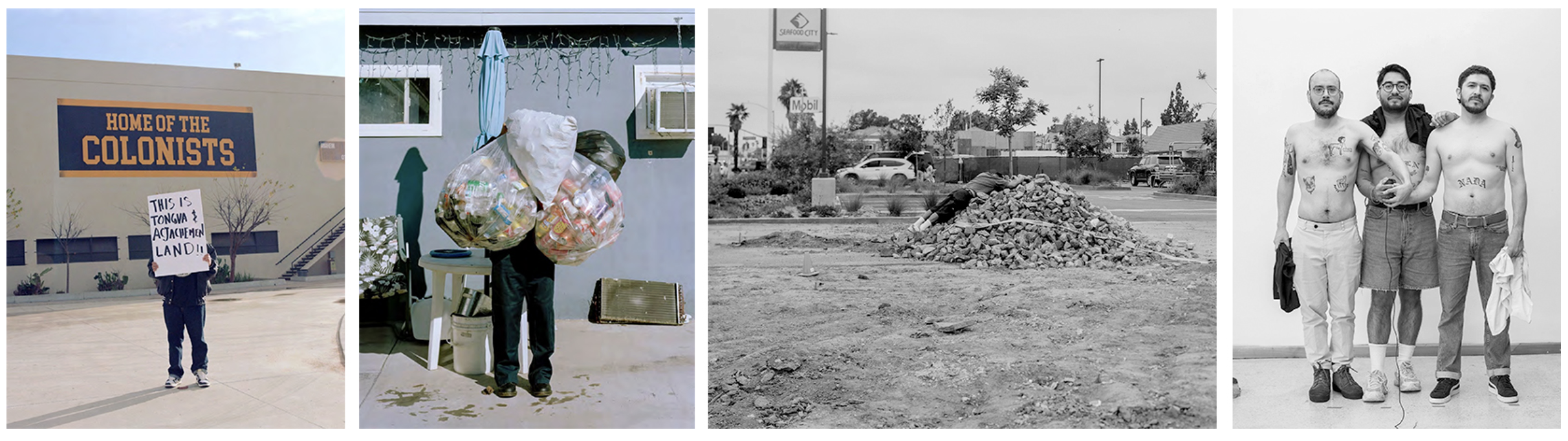
Some of his "interventions" can be seen in photographs like A Colonist Is A Colonist Is A Colonist, (2022) and We Gunna Have To Move Out Soon Fam! (2019). For the former Carmargo appears in front of an Anaheim high school, under a banner that states "Home of the Colonists." His hand written sign — "This is Tongva & Acjachemen Land !!" — is a statement about the origins of people inhabiting the land and posits how the football team can still be called "The Colonists." Similarly, in We Gunna Have To Move Out Soon Fam!, Camargo is pictured in front of a construction site holding a sign that reads: "This area will gentrify soon," calling attention to the impending (and unwanted by some) changes to the neighborhood.
In an evocative series of color self portraits titled All That I Can Carry (2025), Carmargo is depicted holding numerous objects that were cleared out of his family's backyard shed. It is curious that in these images, as well as the ones where he carries signs, his face is obscured. For All That I Can Carry #12 he looks away while holding trash bags stuffed with cans and bottles. In All That I Can Carry #11, he stands in front of a low cinderblock wall in an unkempt garden filled with wispy green plants and dried dirt, a sunhat with a camouflage pattern covering his face. He is casually dressed in cut off blue jean shorts and a tattered t-shirt and is photographed holding a potted plant in one hand and a leaf blower, as well as a toy rifle in the other. Draped over his shoulder is an extension cord as well as a light green cloth bag. The disparate objects that surround him in this image are cues into the life of Carmargo's family, and the process of retrieving them was a catalyst triggering memories of forgotten moments.
Body Interventions (2025), is a new series Camargo shot while in residence in San José, Costa Rica. In these black and white photographs, Camargo positions his outstretched body in vacant lots, over construction materials, or against a fence spray painted with graffiti that states "No + Torres + Parks" (no more towers, more parks), as well as hugging a large sphere which happens to be a pre Columbian artifact. These images not only document his explorations of the city of San José, but also highlight cultural icons and areas undergoing change. As images, the black and white images recall early conceptual photographs like those by Douglas Huebler or Vito Acconci who documented themselves in urban settings to call attention to various aspects of their surroundings or to chart pathways they traveled on urban walks. Carmargo's images also pay homage to John Divola as in a previous series entitled Reimagining the Canon where he is depicted running away from the camera. In, As Far As I Can Get in A Park That Was Segregated In 10 Seconds After Divola, the camera captures him running toward the edge of a lush green park.
Take A Portrait With Me (2025-present) another series from Costa Rica shows Carmago with random Latino men he asked to pose shirtless. In each portrait, his subject holds the cable release controlling when to snap the shutter. Though not friends, there is a varied sense of camaraderie amongst these men, many of whom, like Camargo, have tattooed midsections. The series also investigates masculinity and vulnerability as Camargo's friendly gesture challenges the men to let down their machismo for the camera.
Through these overlapping and intersecting series, Carmago explores personal histories and social constructs. He makes straightforward images (in both black and white and color) that are more documentation than "artful." Nevertheless, when seen together Carmago's powerful works explore gentrification, displacement, family and intimacy. That he can combine these themes across this diverse imagery is a testament not only to his commitment to photography but in his understanding of the history and use of the medium as a tool for advocacy and change.